27 March 1968
Mahasarakham University is a public university that originated from the “College of Education, Maha Sarakham,” established in 1968. It evolved and expanded from the “Prasarnmitr College of Education,” which was an educational institution focusing on teacher training. This was initiated to address the shortage of teaching professionals, accommodate societal growth, enhance the field of education, and extend higher education to regional areas. Various campuses were established as follows:
1. Pathumwan College of Education – Established on June 11, 1955
2. Bangsaen College of Education – Established on July 8, 1955
3. Phitsanulok College of Education – Established on January 25, 1967
4. Maha Sarakham College of Education – Established on March 27, 1968
5. Songkhla College of Education – Established on October 1, 1968
6. Phranakhon College of Education – Established on March 27, 1969
7. Physical Education College of Education – Established on April 1, 1970
Maha Sarakham College of Education Located on Nakhon Sawan Road, Talat Subdistrict, Mueang District, Maha Sarakham Province, Maha Sarakham College of Education was initially led by Dr. Saiyut Champathong as the deputy rector. In its early stages, the college received significant support from Maha Sarakham Teachers’ College in all aspects, including facilities, personnel, teaching equipment, and other resources.
In the 1968 academic year, the college began offering a two-year bachelor’s degree program in Education (B.Ed.) with two majors: English and Biology. It also offered five minor subjects: English, Biology, Chemistry, Thai Language, and Geography. The college admitted a total of 134 students, carefully selected from top-performing graduates holding advanced teaching diplomas (Prathom Krupasit) from teacher colleges across the country.
In the 1970 academic year, the college admitted part-time students for the first time. Its operations steadily developed, with increasing readiness in various areas, adhering to the institution’s mission and philosophy: “Sikkhā Virūḷhi Sampattā“ – “Education is Growth.”
June 29, 1974
Srinakharinwirot University, Maha Sarakham Campus (SWU MS)
In 1974, the Cabinet approved the elevation of the “College of Education” to the status of a “university.” With the royal blessing of His Majesty King Bhumibol Adulyadej (Rama IX), the name “Srinakharinwirot“ (pronounced See-na-ka-rin-wee-rote) was graciously bestowed. The name means “a university that brings honor and prestige to the metropolis.”
All eight Colleges of Education were integrated into Srinakharinwirot University as follows:
1. Srinakharinwirot University, Prasarnmit
2. Srinakharinwirot University, Pathumwan
3. Srinakharinwirot University, Bangkhen
4. Srinakharinwirot University, Physical Education
5. Srinakharinwirot University, Bangsaen
6. Srinakharinwirot University, Maha Sarakham
7. Srinakharinwirot University, Phitsanulok
8. Srinakharinwirot University, Songkhla
Srinakharinwirot University, Maha Sarakham Campus
Srinakharinwirot University, Maha Sarakham Campus, began offering a four-year bachelor’s degree program with various fields of study, including:
Additionally, new faculties and units were established to support the university’s mission and expand its academic and administrative capacity.
December 9, 1994
Mahasarakham University (MSU)
On December 9, 1994, Srinakharinwirot University, Maha Sarakham Campus, became an independent entity under the name Mahasarakham University (MSU). This transition was formalized with the royal signature of His Majesty King Bhumibol Adulyadej (Rama IX) in the University Act, announced in the Government Gazette, Volume 111, Part 54 A. MSU became Thailand’s 22nd public university.
As part of a government policy to reorganize and decentralize universities, several provincial campuses of Srinakharinwirot University were elevated to independent institutions:
Mahasarakham University Located in the upper northeastern region of Thailand, MSU is about 470 kilometers from Bangkok. In 1998, the university relocated its main administrative center from the original Downtown campus (368 rai on Nakhon Sawan Road, Talat Subdistrict, Mueang District, Maha Sarakham) to a new campus in Kham Riang Subdistrict, Kantharawichai District, Maha Sarakham Province, covering 1,300 rai (approximately 7 kilometers from the original campus). This move supported the university’s mission and growth in all aspects.
The original campus (Downtown campus) remains operational, supporting educational and service expansions. Units at this location include:
In addition to its main campuses, Mahasarakham University (MSU) utilizes several other locations within Maha Sarakham Province for educational and research activities. These include:
The Baan Na Si Nuan site has become a new landmark for the university, developed into a learning and agro–tourism destination under a concept of sustainable natural beauty and a healthy environment.
MSU operates under four core missions, which align with its philosophy, “Bahunaṃ Paṇḍito Jīve“ (Public Devotion is a Virtue of the Learned.):
At present, MSU has achieved recognition as part of the Global and Frontier Research University Group, reflecting its emphasis on cutting-edge research. And in 2024, The university offers programs in 17 faculties, 2 colleges, and 1 institute, encompassing a wide range of fields: Humanities and Social Sciences, Science and Technology, Health Science
The university is supported by over 20 administrative and academic units, with an officer of approximately 3,600 personnel, comprising:
MSU serves a student body of approximately 47,000, including around 1,000 international students from 15 countries.
Curriculum
In the academic year 2024, Maha Sarakham University (MSU) offers a total of 203 programs, divided into:
Faculties and Teaching Units
MSU’s academic programs are organized into three major groups as follows:
About Us
Contact
Downtown Campus: 269/2 Nakhon Sawan Rd., Talad Sub-District, Mueang District, Maha Sarakham, 44000, Thailand
Kham Riang Campus: 41/20 Kham Riang Sub-District, Kantharawichai District, Maha Sarakham, 44150, Thailand
Copyright © 2023 All Rights Reserved
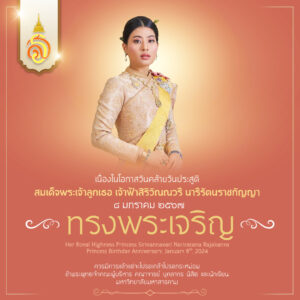
สำนักพระราชวัง ขอเชิญชวนประชาชนร่วมลงนามถวายพระพร สมเด็จพระเจ้าลูกเธอ เจ้าฟ้าสิริวัณณวรี นารีรัตนราชกัญญา เนื่องในโอกาสวันคล้ายวันประสูติ วันที่ ๘ มกราคม ๒๕๖๗ ผ่านระบบออนไลน์ ที่เว็บไซต์หน่วยราชการในพระองค์ https://www.royaloffice.th ระหว่างวันที่ ๗ – ๙ มกราคม ๒๕๖๗





